HVAC License Requirements by State: What You Need, and How to Keep It From Lapsing
Which states require an HVAC license, the tiers that stack on top of EPA 608, and how to track renewals so a lapsed license never fails an inspection.
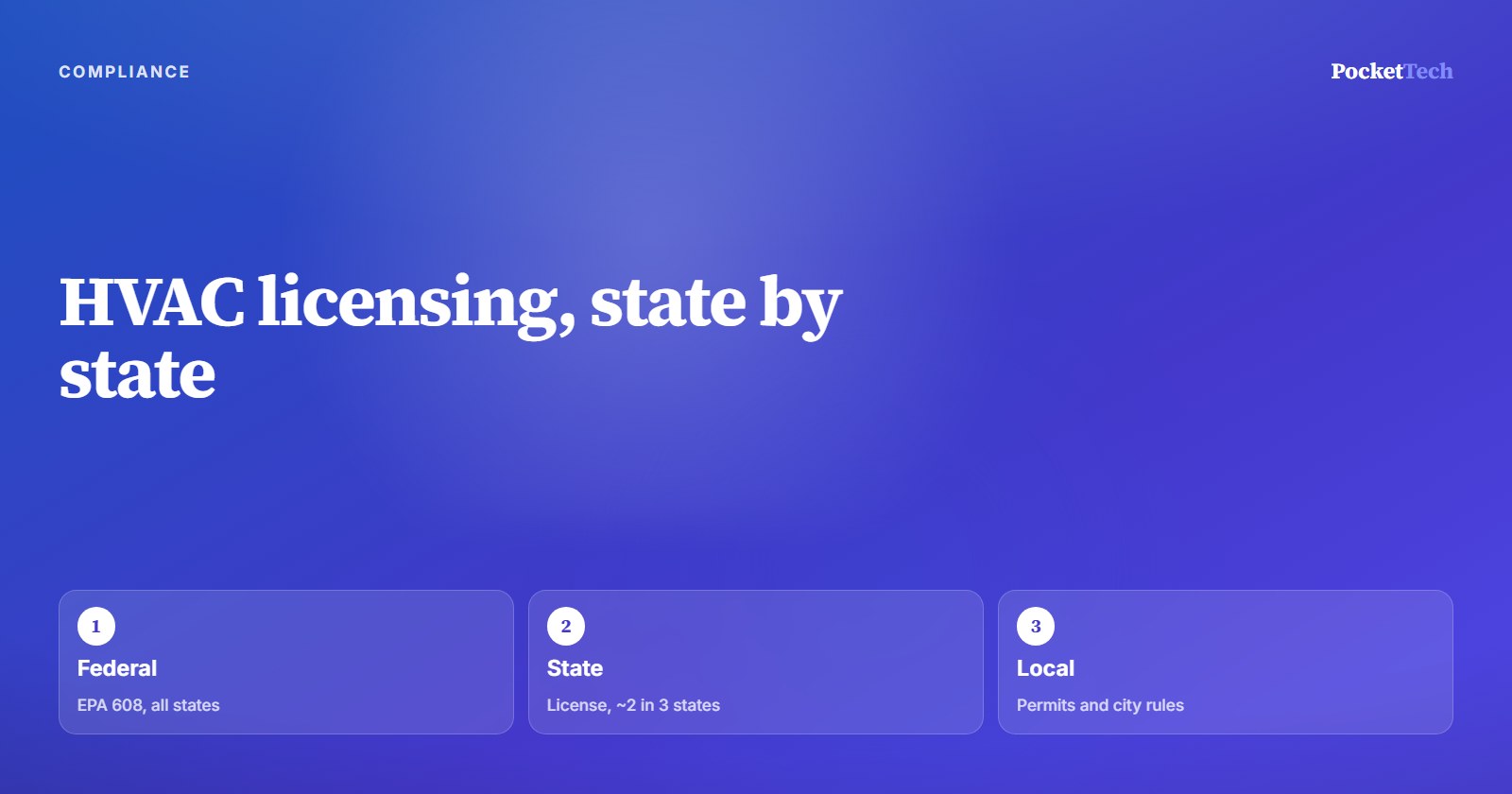
There is no such thing as a national HVAC license. That single fact is why licensing trips up so many otherwise well-run shops. The rules change the moment you cross a state line, sometimes the moment you cross a county line, and the credential that made you fully legal in one jurisdiction can leave you working illegally in the next one over.
The good news: the rules themselves are knowable. The hard part is not learning them once. It is keeping every tech’s license, every business license, and every permit current across renewal cycles that never line up. This guide covers what actually varies by state, the tiers that stack on top of your federal EPA 608, and the tracking system that keeps a quietly expired license from failing an inspection.
The three layers of “am I licensed to do this job?”
Almost every HVAC licensing question collapses into three separate layers. Confusing them is where shops get burned.
- Federal certification (EPA Section 608). Anyone who maintains, services, or disposes of equipment containing refrigerant must be 608-certified. This is identical in all 50 states and, importantly, does not expire. It is the floor, not the finish line.
- State or local licensing. This is the layer that varies. Most states issue a statewide HVAC or mechanical contractor license; others hand it to cities and counties; a few require nothing HVAC-specific at all.
- Per-job permits and inspections. Even fully licensed, most installs and many repairs need a mechanical permit pulled and an inspection passed. The threshold for when a permit is required is itself set locally.
Are HVAC licenses state-specific? (Yes, and here is the split)
We compiled the current state-level rules into an interactive HVAC license by state map and table. Grouped by how each state handles licensing, the picture looks like this:
| Category | Roughly how many | What it means | What to do |
|---|---|---|---|
| Statewide license | ~36 (incl. D.C.) | The state issues and requires an HVAC/mechanical contractor license to do the work | Hold the state license; track its renewal (usually every 1 to 3 years) |
| Local / city only | ~14 | No statewide HVAC license; cities and counties license instead (e.g. Kansas, Michigan, Pennsylvania) | Check every jurisdiction you work in; a license in one city may not cover the next |
| No HVAC-specific license | Rare | No state or common local HVAC contractor license required | Confirm anyway; general business registration and permits still apply |
So yes, licensing is state-specific, and roughly two in three states run it at the state level. The rest push the decision down to local authorities, which is the trap for shops that expand into a neighboring county and assume their existing license carries over. Look up your exact state and its licensing authority in the state-by-state tool before you rely on any rule of thumb.
The license tiers that stack up
Where a state does license HVAC work, it usually does so in tiers. The exact names differ, but the ladder is consistent:
- Apprentice / trainee: works under supervision, no independent authority.
- Journeyman: licensed to perform the work, typically after documented hours plus an exam.
- Master / contractor: the senior tier that can pull permits, supervise others, and often serve as the “qualifying party” whose credential the business license is built on.
- Business / contractor license: held by the company itself, frequently tied to a qualifying party who holds the master-level individual license.
The one that most often lapses without anyone noticing is the business/contractor license, because it renews on the company’s clock rather than an individual tech’s, and no single person feels responsible for it.
What is the “$5,000 rule” for HVAC?
This question comes up constantly, and the honest answer is that there is no single national “$5,000 rule.” It is shorthand for a dollar threshold, set by each state or locality, above which a job legally requires a licensed contractor or a pulled permit. The figure is all over the map:
- California requires a licensed contractor once a project’s combined labor and materials reach $1,000, a threshold raised from $500 effective January 1, 2025 under AB 2622 (CSLB). A permit requirement also triggers the license requirement regardless of cost.
- Other states and municipalities set the bar higher, and some of those figures land near $5,000, which is where the phrase comes from.
Which HVAC license do your techs actually need?
There is no universally “best” license; the right stack depends on the work and the state. For most residential and light-commercial shops it comes down to:
- EPA 608, Type II or Universal, for anyone touching refrigerant. (If you are unsure which type applies, see our breakdown of the EPA 608 certification types.)
- A state or local contractor/mechanical license for the business, held by a qualifying party at the master tier where the state requires it.
- Individual journeyman or master licenses where the state licenses techs personally rather than only the company.
Working across state lines: reciprocity
If you operate near a border or plan to expand, reciprocity matters. Many states have agreements that recognize an out-of-state license and waive the trade exam for contractors in good standing. The catch: they almost always still require the destination state’s business and law exam, proof of experience, and fees. Reciprocity speeds up the process; it does not skip it, and it is never automatic. Confirm the terms with the board in the state you are entering before you accept work there.
The part that actually bites you: renewals
Knowing the rules is the easy half. The failure mode is rarely “we never got licensed.” It is “the license expired three weeks ago and nobody was watching.” State and local licenses typically renew every 1 to 3 years, individual credentials renew on their own schedules, and permits carry inspection deadlines, none of which line up. EPA 608 is the one credential that does not expire, which ironically makes it the one people track and the expiring licenses the ones they forget.
The typical system is a spreadsheet plus the office manager’s memory. Both share one fatal flaw: nothing warns you a deadline is coming. You find out a license lapsed when an inspector asks for it or a warranty claim gets denied.
A system that holds looks different:
- One record per license and per credential, per tech and per entity, with issue date, expiry, jurisdiction, and a scanned copy attached.
- Reminders that fire early (90, 30, and 7 days out) to both the tech and the office, so it is never one person’s job to remember.
- A single dashboard answering “are we covered?” in five seconds instead of a filing-cabinet expedition.
This is the corner most field service platforms ignore. Even the big incumbents like ServiceTitan treat credentials as an afterthought. We built PocketTech’s compliance tracking specifically to close it: every license and certification on every tech, every permit on every job, on one dashboard with the reminder cadence running in the background so a lapse cannot sneak up on you. For the full picture of how the layers fit together, start with The HVAC Compliance Handbook, and to try tracking it yourself, use our free HVAC credential and permit tracker or read how credential tracking works in PocketTech.
The bottom line
HVAC licensing is state-specific by design, stacked in tiers, and gated by dollar thresholds that vary by locality. You can learn your state’s rules in an afternoon. Staying compliant year after year is the real work, and it is a tracking problem, not a knowledge problem. The shops that never get caught are not the ones with the best memory. They are the ones who stopped relying on it.
Frequently asked questions
Are HVAC licenses state-specific?
Yes. There is no national HVAC contractor license. Roughly two-thirds of states (about 36 including Washington, D.C.) issue a statewide HVAC or mechanical license, around 14 leave licensing to cities and counties, and a handful require no HVAC-specific license at all. On top of that, everyone who handles refrigerant needs the federal EPA Section 608 certification, which is the same in all 50 states.
What is the '$5,000 rule' for HVAC?
There is no single national '$5,000 rule.' It is shorthand for a dollar threshold, set by each state or locality, above which a job legally requires a licensed contractor or a pulled permit. The number varies widely: California, for example, requires a licensed contractor once a job's combined labor and materials hit $1,000 (raised from $500 on January 1, 2025), while some jurisdictions use a higher figure closer to $5,000. Always confirm the threshold with your state board, not a rule of thumb.
Which HVAC license do my techs actually need?
It depends on the work and the state. Almost every tech who touches refrigerant needs EPA 608 (usually Type II or Universal). To pull permits and legally contract HVAC work, your business typically needs a state or local contractor/mechanical license held by a qualifying party, and some states also license individual journeyman and master technicians. Look up your state to see which tiers apply.
Does an HVAC license transfer between states?
Sometimes, through reciprocity. Many states have agreements that recognize an out-of-state license and waive the trade exam, but they almost always still require the destination state's business and law exam, proof of experience, and fees. Reciprocity is never automatic. Confirm the details with the board in the state you want to work in before you take a job there.